

Understanding Spotify Part 4: Taking Action
Putting it all to work for your music, and when to phone a friend.

This week I’ll be releasing “The Long Run,” my song inspired by a running playlist. But before I do I wanted to wrap up this Understanding Spotify series with something practical for you.
This also marks the opening of my calendar for Release Strategy Sessions: one hour sessions where I help you plan and strategize around your release.
More on that below, or jump right in and book your session.
Ready, Steady…Careful Now.
Understanding ≠ Results
So, you’ve set aside your negativity bias, you understand The Score and what Spotify “wants.” (If you don’t know what I’m talking about, go back and read Parts 1 - 3 of this series.
Now - how do you put all this newfound knowledge to work? For that, I’ll walk you through the first half of my Song Release Checklist. I’m sorry I don’t have a snappier name for it. It’s an Apple Note I keep adapting as my understanding of releasing music in the age of the algorithm changes.
There’s a version for paid subscribers here:

But the bigger question is - how do you do it without re-opening the dread Music Business Trauma™?
I think it’s right to be cautious about this.
Knowledge is power, but confusing understanding with the expectation of results has led to some of the most painful lessons of my career.
That’s where having a “Why” really helps.
Goal-Setting Helps…But Maybe Not That One
Their goal ≠ Yours
Behind all of this, before the music, before the strategy, you really have to start by having a clear, articulated sense of what your end goal is.
A common trap for many of us is falling back on an ill-considered goal like “getting on the cover of Rolling Stone and touring the world!”
This happens entirely by accident because most of us haven’t spent any time making peace with the fact that a goal like that is (probably) not ours. Take a moment and notice if you accidentally have a goal like that which is totally out of whack with your reality.
A useful prompt is to keep asking, “Then what?”
Someone hears your song on Spotify. Then what?
They click through to your profile. Then what?
They follow you, join your email list, come to a show, or eventually stand in front of you. Then what?
If the answer gets fuzzier as they move closer, you may know that you want an audience without yet knowing what you want to offer them that no one else can.
Here are three examples of real goals of real artists that I’ve worked with:
One artist came to me with the goal of simply enjoying putting out music again.
Another wants to tour the West Coast two weeks a year.
And yet another wants to give her most personal work yet a platform to reach other people who struggle with the same stuff she did.
Some of those are a little mushy and some are extremely practical. A “perfect” goal probably has both: Mushy will get you motivated and practical will keep you in the game.
But simply grappling with this concept in any meaningful way will help you avoid burnout or resentment.
Here’s my goal for releasing my music: Stay connected to my artist self so I can show up in my life (mushy), and give my work as a creative consultant credibility so the right artists can trust what I offer (practical).
Try it yourself. You don’t have to know it exactly, it’s just something to keep playing with.
“I make and release music so that ______ because ______”
And this may go without saying, or it may in fact require a separate piece: You are not going to build a sustainable, fulfilling music career inside Spotify—or any DSP. These platforms can give your music extraordinary reach, but reach is not the destination. Your job is to create a compelling world that gives the right listeners somewhere to go once they find you on a place like Spotify.
Remember: you bring them in closer and…then what?
Ok, with all that out of the way, here are some things you can do to bring the music to market without losing your mind.
One tip: Before you begin - have more than one song ready to go.
That means at least one mastered song with artwork and confidence you’ll be able to follow that one up within a month or so. I waited until I had three songs completely finished and was well on my way to three more before I kicked off my release journey.
8 Weeks+ Ahead of Time: Preparing Source Material
The deeper the well, the sweeter the water.
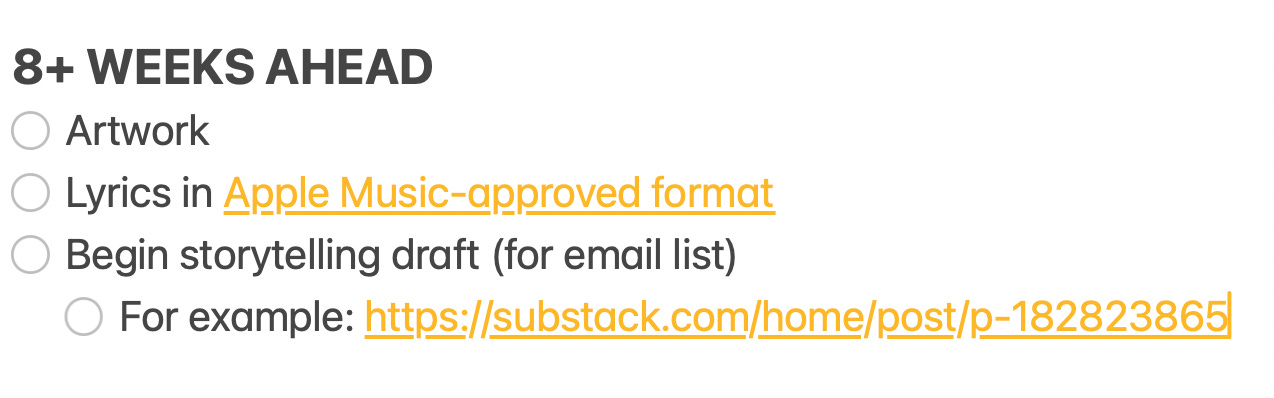
Eight weeks ahead I’m thinking about artwork - a post of its own, but suffice it to say, express the mood of the song in a way that you’re excited about and work with a designer if you’re stuck.
Then I’m making sure the lyrics are in the correct format.
Finally, I’m beginning the storytelling draft.
What does that mean?
Well, those long stories that I write about the songs serve two purposes - I like to write them and I think my audience has come to expect them (I can back that up with data, they have high open rates with good click-through rates).
But those essays aren’t just for readers. They become the raw material for everything else. A thousand thoughtful words can become a Spotify editorial pitch, a few social posts, an email subject line, or the two sentences you say when someone asks what your song is about.
I think of video content the same way. The long-form videos are fun to do, and when I have an idea for one that I can do affordably with a friend, I do it because I like it. But a long-form music video is the pool of visuals I draw from to create things like the 8 seconds (max!) for a Spotify Canvas.
So: write the story of your song and the project as a whole. It doesn’t have to be for your email list (although I encourage you to share it there), but it should be long.
You can use a prompt for an AI of your choice to help tease it out of you if you’re reluctant to free write. Here’s one:
Interview me like an excellent music journalist preparing a deeply reported profile about my latest song and the larger project it belongs to.
Your goal is not to write the article yet. Your goal is to help me uncover detailed, specific source material I can later use for long-form storytelling, editorial pitches, press materials, social posts, and conversations about the release.
Ask me at least 20 questions, one at a time. Follow up whenever an answer contains an unexplored emotional, narrative, musical, or biographical thread. Ask about the song’s origin, lyrics, production choices, collaborators, personal stakes, cultural context, contradictions, and relationship to the songs that will follow.
Push me past generic answers. Ask for scenes, memories, exact moments, sensory details, and the things I may be reluctant to say. Challenge assumptions where useful, but do not impose a narrative before the interview is complete.
4-6 Weeks Ahead: The Work
Sometimes you do just have to sit in front of a computer.
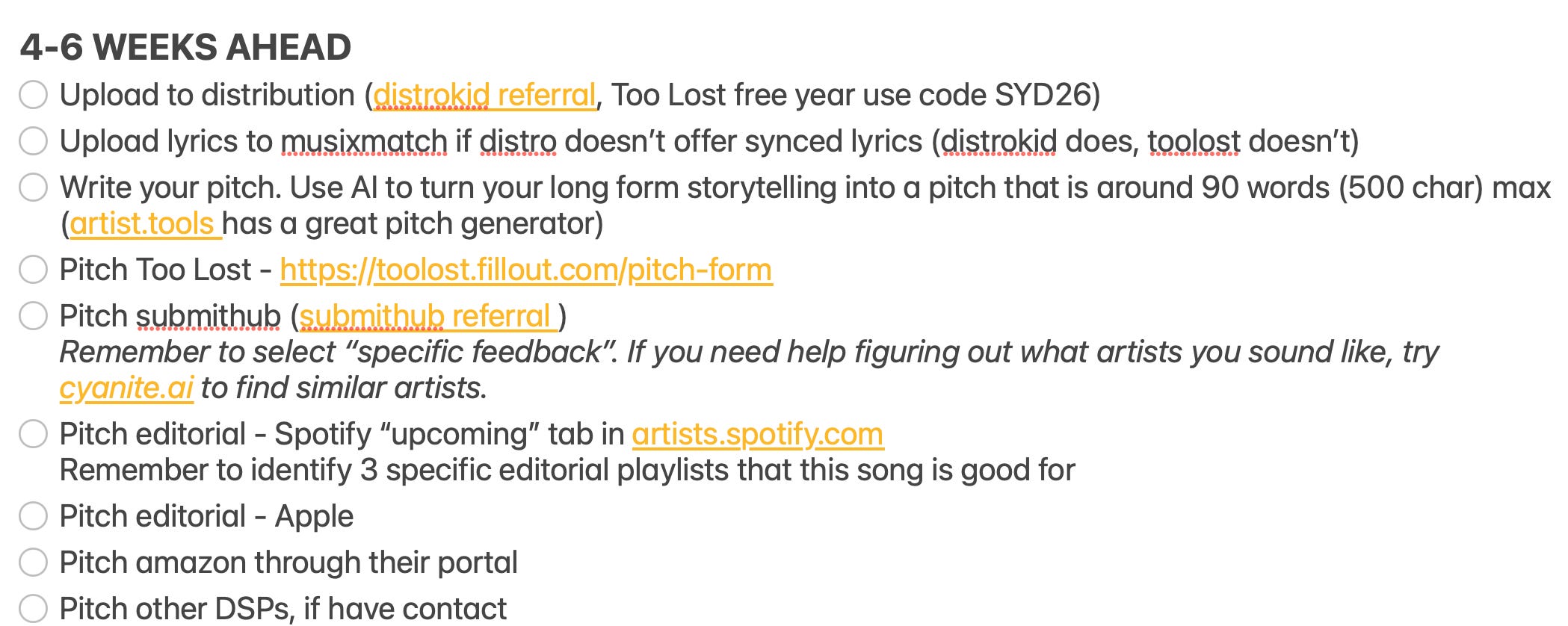
This is where the main flurry of activity takes place. If you understand how it works, platforms like SubmitHub and pitches like those made to Spotify Editorial now should make more sense to you. They are simply channels for letting the wider world know what you are doing. There are a million approaches and approximately a billion articles explaining them all.
Here’s just a free-association list of stuff I think is important to know:
For those that grew up in the age of the physical press kit, think of the money you spend to submit songs on these song submission platforms as postage.
SubmitHub is good and affordable. Groover is neither. Magic Nothing is pretty great for released music, but pricey, so be picky. Beyond them, the landscape gets crowded quickly with also-rans and services I would not trust.
When you submit music, listen to the playlist you are submitting to and support the creators who support you - give a shout out to those playlists that make a measurable difference in your streams.
Don’t take SubmitHub’s advice to call out sections of your track like “check out the drop at 2:10!” - being on the receiving end of comments like that is a turn off as a curator. A short sentence that sounds human you along with music that really does perfectly match their playlist is all you need.
When submitting to editorial, always, always, always tell them the kinds of playlists your song is best suited for. It’s how they route to the right editors.
The tools that Aaron has built at artist.tools are worth the money if you want to track your popularity score and write good editorial pitches.
Cyanite.ai has a janky interface, but it is the best tool I’ve found for productive rabbit holes through similar artists and potentially relevant editorial playlists. As with any service analyzing unreleased music, check the current terms before uploading anything sensitive.
Find a distributor that reliably handles the basics. DistroKid gets it done, as does TuneCore. I’ve found a home at Too Lost: it is solid, affordable, supports master splits without requiring every collaborator to maintain a paid account, and I have someone I can contact when I need help. Use code SYD26 if you decide to use Too Lost.
Yes, there’s more. There’s the week of release and there’s the week after. That’s all in my Song Release Checklist, which you can get by either being a paid subscriber or using your free pass to view.
You Got This…But If You Don’t, I Can Help
Sometimes you need to phone a friend.

It’s a lot! I’ve tried to break it down as best as I can, but the tools keep changing, every release has different needs, and I haven’t even gotten to advertising or building your own playlists yet.
If you want to give it a try but are still feeling overwhelmed, I can help.
I now offer one-hour release-strategy consultations on a judgement-free sliding scale of $100–$250.
Every session is a little different. Sometimes we’re figuring out the story. Sometimes we’re rewriting an editorial pitch. Sometimes we’re deciding whether you should spend a dollar on ads at all. Mostly, we’re trying to build a release plan that fits your music and your actual life.
Some artists come back for feedback or ask me to handle specific pieces.
Many leave the first hour with everything they need to move forward on their own.
Syd